Enter The Video Store: Empire of Screams: Limited Edition – Arrow Video (Blu-ray)

Theatrical Release Dates: USA, 1984 (The Dungeonmaster), USA/Italy, 1986 (Dolls), USA, 1987 (Cellar Dweller), Italy, 1989 (Arena), USA/Italy (Robot Jox)
Directors: David Allen, Charles Band, John Carl Buechler, Steven Ford, Michael Karp, Peter Manoogian, Ted Nicolaou, Rosemarie Turko (The Dungeonmaster), Stuart Gordon (Dolls, Robot Jox), John Carl Buechler (Cellar Dweller), Peter Manoogian (Arena)
Cast: Jeffrey Byron, Richard Moll, Leslie Wing, Gina Calabrese (The Dungeonmaster), Ian Patrick Williams, Carolyn Purdy-Gordon, Carrie Lorraine, Guy Rolfe, Hilary Mason, Bunty Bailey, Cassie Stuart, Stephen Lee (Dolls), Paul Satterfield, Hamilton Camp, Claudia Christian, Marc Alaimo, Shari Shattuck, Armin Shimerman, Brett Porter (Arena), Gary Graham, Anne-Marie Johnson, Paul Koslo, Robert Sampson, Danny Kamekona, Hilary Mason, Michael Alldredge, Jeffrey Combs, Ian Patrick Williams (Robot Jox)
Release Date: June 26th, 2023 (UK), June 27th, 2023 (USA)
Approximate Running Times: 73 Minutes 35 Seconds (The Dungeonmaster - U.S. Theatrical Version), 77 Minutes 59 Seconds (The Dungeonmaster - Pre-release Version under the title Ragewar), 77 Minutes 23 Seconds (The Dungeonmaster - International Version under the title Ragewar), 77 Minutes 29 Seconds (Dolls), 77 Minutes 36 Seconds (Cellar Dweller), 97 Minutes 20 Seconds (Arena), 84 Minutes 27 Seconds (Robot Jox)
Aspect Ratio: 1.85:1 Widescreen / 1080 Progressive / MPEG-4 AVC (All Films)
Rating: 18 (UK), R (USA)
Sound: LPCM Mono English (The Dungeonmaster All Versions), LPCM Stereo English (Dolls, Cellar Dweller, Arena, Robot Jox), DTS-HD 5.1 English (Dolls)
Subtitles: English SDH (All Films)
Region Coding: Region A,B
Retail Price: £69.99 (UK), $99.95 (USA)
"Remember the shelves of your local video store? Those days aren't gone! Reject reality and substitute your own with Arrow Video! In 1983, entrepreneurial producer and director Charles Band founded Empire International Pictures, which would go on to make some of the most memorable and beloved genre movies of the 1980s. Empire became a mainstay of video stores across the world with their catchy titles, outlandish art and Band's wholehearted belief in giving audiences a good time. Freshly restored for the digital era with a wealth of new and archival extras, these films have never looked better. No need for a time machine, these golden age video classics will send you back to the 80s!
In The Dungeonmaster (AKA Ragewar), computer programmer Paul Bradford is sucked into a fantasy world by Mestema, a demonic sorcerer in search of a worthy opponent. Meanwhile, fresh from the one-two punch of Re-Animator and From Beyond, director Stuart Gordon takes a turn toward fairytale gothic in Dolls, in which a group of strangers find themselves forced to seek shelter at the isolated home of an old toymaker and his wife, only to find that the puppets and dolls have a vicious life of their own. In Cellar Dweller, a comic book artist (Jeffrey Combs) with a penchant for the macabre takes inspiration from an ancient tome and unleashes an ancient evil. Arena presents the ultimate fight night event: man vs monster! In the far future of 4038, a short order cook becomes the first human in fifty years to compete in an intergalactic boxing event on the far side of the universe. Finally in Robot Jox, Stuart Gordon directs Empire Pictures' most ambitious movie yet, as men and women pilot giant machines in gladiatorial battle to settle international disputes over territory." - synopsis provided by the distributor
Video: 3.5/5 (Arena), 4/5 (Cellar Dweller), 4.25/5 (The Dungeonmaster All Versions), 4.5/5 (Dolls, Robot Jox)
Here’s the information provided about The Dungeonmaster's transfers, "The original 35mm negative was scanned in 4K resolution at Company 3, Los Angeles. The film was graded and restored in 2K resolution at R3Store Studios. Additional materials, including a high-definition feature master from MGM, were sourced to assemble and present the 3 different cuts of the film."
The Dungeonmaster comes on a 50 GB dual layer Blu-ray.
Disc Size: 34.5 GB
Feature: 23.8 GB
The source used is in great shape; it is a marked improvement over all of this film’s previous home video releases. Flesh tones look healthy, color saturation and black levels are strong, the image looks crisp, compression is solid, and the image always looks organic. That said, the three sources are similar quality-wise.
Here’s the information provided about Dolls' transfer, "An original 35mm interpositive was scanned in 2K resolution at Company 3, Los Angeles. The film was graded and restored in 2K resolution at R3Store Studios."
Dolls comes on a 50 GB dual layer Blu-ray.
Disc Size: 40.2 GB
Feature: 23.7 GB
The source used for this transfer looks excellent, and any blemishes that still remain are very minor. Flesh tones look healthy, colors are nicely saturated, image clarity, black levels, and compression are solid, and the image always looks organic. That said, this transfer is easily the best this film has ever looked on home video.
Here’s the information provided about Cellar Dweller's transfer, "A high-definition feature master was supplied by MGM via Park Circus. Additional grading and picture restoration was completed by R3StoreStudios."
Cellar Dweller comes on a 50 GB dual layer Blu-ray.
Disc Size: 35.5 GB
Feature: 20.7 GB
The source used for this transfer is in great shape, and any source-related debris has been cleaned up. Colors and flesh tones look correct, the image looks crisp, black levels are strong, compression is solid, and grain remains intact. That said, this transfer is another improvement when compared to this film’s previous home video releases.
Here’s the information provided about Arena's transfer, "A 35mm theatrical print was scanned in 2K resolution at Company 3. The film was graded and restored in 2K resolution at AGFA. The quality master is in keeping with the available print materials. The opening titles offset was an error in the initial film printing and has been retained for this presentation."
Arena comes on a 50 GB dual layer Blu-ray.
Disc Size: 46.5 GB
Feature: 28.1 GB
Considering the limitations of the source materials available, this transfer looks better than expected, and it is easily the best this film has looked on home video. Colors look good, the image generally looks crisp, black levels fare well, and compression is solid.
Here’s the information provided about Robot Jox's transfer, "The original 35mm negative was scanned in 4K resolution at Company 3. The film was graded and restored in 2K resolution at R3Store Studios."
Robot Jox comes on a 50 GB dual layer Blu-ray.
Disc Size: 37.9 GB
Feature: 19.7 GB
The source used for this transfer looks excellent; it is another solid upgrade that is superior to all of this film’s previous home video releases. Flesh tones look healthy, color saturation, image clarity, black levels, and compassion are solid, and the image always looks organic.
Audio: 3.75/5 (LPCM Stereo English - Arena), 4/5 (LPCM Mono English - The Dungeonmaster All Versions, LPCM Stereo English - Cellar Dweller, LPCM Stereo English - Robot Jox), 4.25/5 (DTS-HD 5.1 - Dolls, LPCM Stereo English - Dolls)
All three versions of The Dungeonmaster come with one audio option, a LPCM mono mix in English, and all three versions come with removable English SDH subtitles.
Cellar Dweller, Arena, and Robot Jox each come with one audio option, a LPCM stereo mix in English, and all three films come with removable English SDH subtitles.
Dolls comes with two audio options, a DTS-HD 5.1 mix in English and a LPCM stereo mix in English. Included are removable English SDH subtitles.
All of these audio tracks are in very good shape. Dialog always comes through clearly, and everything sounds balanced. That said, though ambient sounds are well represented, range-wise, these audio tracks are best described as serviceable. The two audio tracks for Dolls are the strongest.
Extras:
Extras for The Dungeonmaster include reversible cover art, an image gallery (11 images - stills/home video art), a theatrical trailer (1 minute 57 seconds, LPCM mono English, no subtitles), an alternate theatrical trailer (3 minutes 2 seconds, Dolby Digital mono English, no subtitles), an interview with actor Jeffrey Byron titled I Reject Your Reality and Substitute My Own (15 minutes 7 seconds, Dolby Digital stereo English, no subtitles), and an audio commentary with Jeffrey Byron, moderated by film critics Matty Budrewicz and Dave Wain.
Extras for Dolls include reversible cover art, an image gallery (51 images - stills/home video art), a theatrical trailer (2 minutes 34 seconds, LPCM stereo English, no subtitles), an alternate theatrical trailer (4 minutes 24 seconds, Dolby Digital stereo English, no subtitles), UK home video trailer (1 minute 35 seconds, Dolby Digital stereo English, no subtitles), film-to-storyboard comparison (8 minutes 30 seconds, Dolby Digital stereo English, no subtitles), an archival featurette titled Toys of Terror: The Making of Dolls (38 minutes 31 seconds, LPCM stereo English, no subtitles), an interview with editor Lee Percy titled Assembling Dolls (17 minutes 1 second, LPCM stereo English, no subtitles), an archival audio commentary with director Stuart Gordon and screenwriter Ed Naha, an archival audio commentary with cast members Carolyn Purdy-Gordon, Stephen Lee, Carrie Lorraine, and Ian Patrick Williams, and an audio commentary with David Decoteau, Empire alumnus and friend of Stuart Gordon.
Extras for Cellar Dweller include reversible cover art, image galleries: behind the scenes (1 minute 40 seconds), and artwork and stills (43 images), original sales sheet, original production notes, a VHS trailer (1 minute 15 seconds, Dolby Digital stereo English, no subtitles), an interview with special make-up effects artist Michael Deak titled Inside the Cellar (16 minutes 30 seconds, Dolby Digital stereo English, no subtitles), a new appreciation of John Carl Buechler, special make-up effects artist of many Empire Pictures films and director of Cellar Dweller, by film critics Matty Budrewicz and Dave Wain titled Grabbed by the Ghoulies (16 minutes 3 seconds, Dolby Digital stereo English, no subtitles), and an audio commentary with Michael Deak, moderated by film critics Matty Budrewicz and Dave Wain.
Other extras on this disc include two trailer reels: More Films by Empire Pictures (11 minutes 23 seconds, Dolby Digital stereo English, no subtitles), which has the following trailers: Ghoulies, Ghoulies II, Breeders, Eliminators, Crawlspace, From Beyond, and Prison; and More Films by Empire Pictures VHS Mode (17 minutes 1 second, Dolby Digital stereo English, no subtitles), which has the following trailers: Ghoulies, Eliminators, From Beyond, Terrorvision, Troll, Enemy Territory, Catacombs, Ghost Town, and Crawlspace.
Extras for Arena include reversible cover art, image galleries: behind the scenes (1 minute 6 seconds), and posters and stills (27 images), a theatrical trailer in 16:9 aspect ratio (1 minute 40 seconds, Dolby Digital stereo English, no subtitles), a theatrical trailer in 4:3 aspect ratio (1 minute 41 seconds, Dolby Digital stereo English, no subtitles), an interview with special make-up effects artist Michael Deak titled Empire of Creatures (16 minutes 21 seconds, Dolby Digital stereo English, no subtitles), an interview with screenwriter Danny Bilson titled Not His Arena (14 minutes 44 seconds, Dolby Digital stereo English, no subtitles), an alternative full frame presentation of Arena (97 minutes 15 seconds, Dolby Digital stereo English, no subtitles), and an audio commentary with director Peter Manoogian, moderated by film critics Matty Budrewicz and Dave Wain.
Extras for Robot Jox include reversible cover art, image galleries: behind the scenes (9 minutes 14 seconds), and posters and stills (113 images), a theatrical trailer in 16:9 aspect ratio (1 minute 25 seconds, Dolby Digital stereo English, no subtitles), original sales sheet, original production notes, archival behind the scenes photos by Paul Gentry titled Salvaged from the Wreckage (8 minutes 19 seconds, Dolby Digital stereo English, no subtitles), an archival interview with actor Paul Koslo titled Looking Back (10 minutes 24 seconds, Dolby Digital stereo English, no subtitles), a new appreciation of stop motion animator David Allen by those who knew him, featuring contributions from fellow visual effects artists Steve Burg, Yancy Calzeda, Paul Gentry, among others titled The Scale of Battle: David Allen and the FX of Robot Jox (26 minutes 35 seconds, Dolby Digital stereo English, no subtitles), an interview with actor Anne-Marie Johnson titled Her Name is Athena (13 minutes 25 seconds, Dolby Digital stereo English, no subtitles), an interview with actor Gary Graham titled Crash and Burn (17 minutes 9 seconds, Dolby Digital stereo English, no subtitles), an archival audio commentary with director Stuart Gordon, and an archival audio commentary with associate effects director Paul Gentry, mechanical effects artist Mark Rappaport, and stop-motion animator Paul Jessell.
Rounding out the extras is double sided posters for each film featuring original and newly commissioned artwork, 15 postcard-sized reproduction artcards, Arrow Video store membership card, and an eighty page booklet with cast & crew information for each film, an essay titled Emperor of the "B"s: The Rise and Fall of Empire Pictures written by Dave Jay, an essay titled Substituting Realities: The Unmaking of The Dungeonmaster written by Dave Jay, an essay titled Dolls: Stuart Gordon's Grown-Up Fairy Tale with Sharp Teeth written by Meagan Navarro, an essay titled Horror Comics, Monsters and Artistic Integrity in Cellar Dweller written by Lee Gambin, an interview with John Carl Buechler, an essay titled Body and Soul in Outer Space: The Making of Arena written by Dave Joy, an essay titled Drop Your Jox! These Robots Don't Need Any Disguise written by John Harrison, Robot Jox Production Notes, and information about the restorations.
Summary:
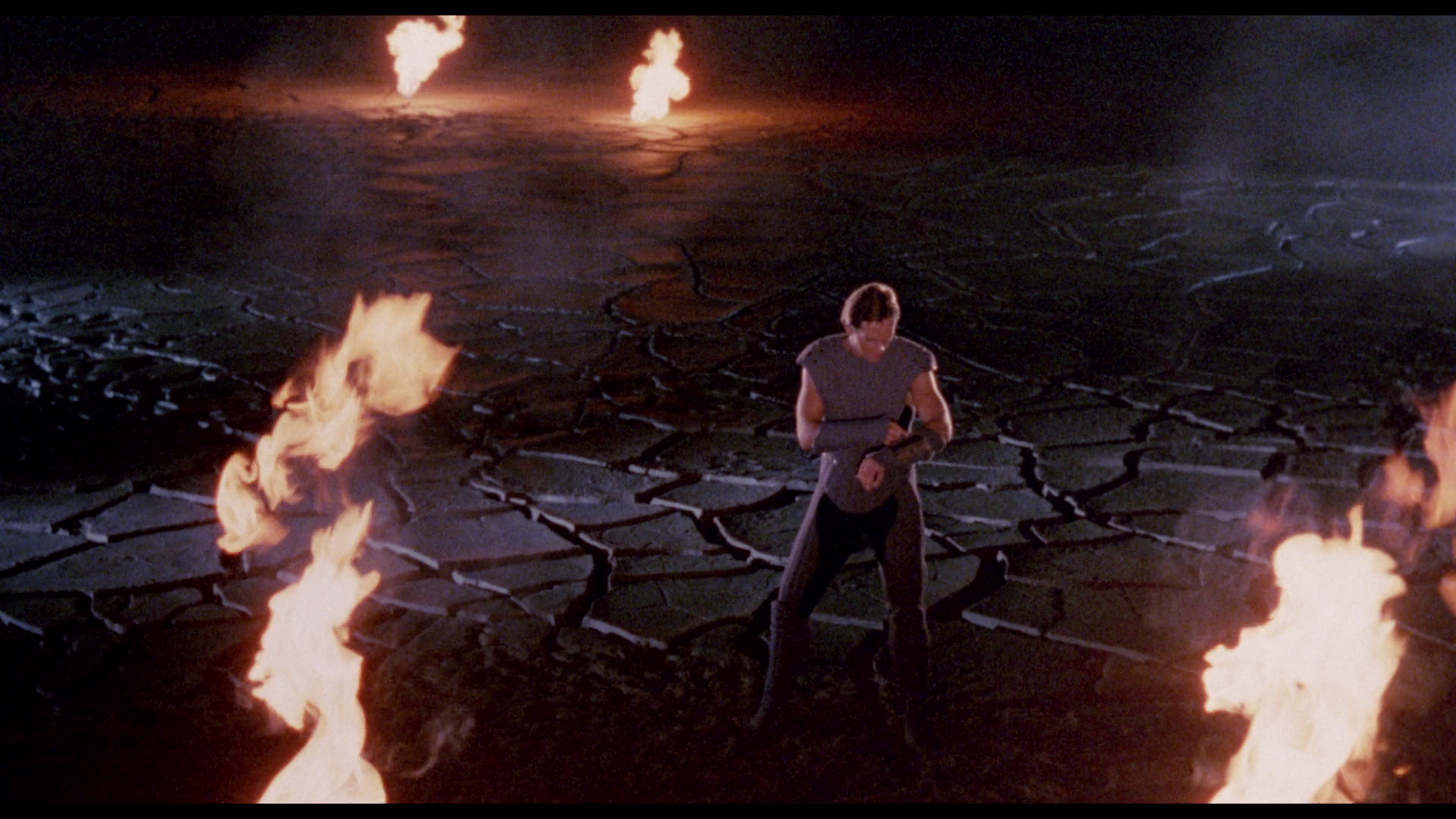
The Dungeonmaster: Directed by eight directors The Dungeonmaster is an uneven film that feels more like a collection of moments than a cohesive narrative. There are three versions of The Dungeonmaster; the differences between these three versions are that a prerelease version titled Ragewar has nudity and a pre-credits dream sequence, both of which are missing from the version known as The Dungeonmaster, and there is an international version also under the title of Ragewar that retains the pre-credits dream sequence but drops the nudity and rearranges some scenes.
The narrative revolves around a computer programmer who finds himself in a battle against a demonic wizard.
Depending on which version you watch, it will change your outlook. The versions that open with the pre-credits dream sequence start off on a stronger foundation. This opening sequence has an ample amount of atmosphere, and the tone of this sequence is far more sinister than anything that follows. From there, the narrative is nothing more than a series of moments where the protagonist is faced with challenges; there is no time devoted to building characters.
The performances suit the story at hand. With the standout performance being Richard Moll (House) in the role of a wizard named Mestema. His performance is best described as over the top. The most memorable performance is that of Gina Calabrese, who is the girl in the pre-credits dream sequence.
From a production standpoint, it is clear that The Dungeonmaster is a film working with limited resources. Though the premise of a computer programmer who finds himself in a virtual reality that pits him against creatures and deadly obstacles is full of possibilities, The execution of said premise is a bumpy ride. Also, the CGI special effects are noticeably dated. That said, there are a few areas where The Dungeonmaster comes out ahead: Richard Band’s (Re-Animator) solid score that does a great job setting the mood, and cinematographer Mac Ahlberg’s (From Beyond) stylish cinematographer. Ultimately, The Dungeonmaster has an interesting premise that is let down by its anemic resources.
Dolls: Directed by Stuart Gordon in the same year he directed From Beyond. His other notable films include Re-Animator, The Pit and the Pendulum (1991), Castle Freak, and Dagon. Though Dolls is not scored by Richard Band, a frequent collaborator of Staurt Gordon, it does feature a very effective score by Fuzzbee Morse.
The narrative revolves around a dysfunctional family: a father, his daughter, and a stepmother whose car breaks down during a storm in front of a secluded mansion. Once inside the mansion, the family meets its inhabitants, an elderly couple and their large collection of life-like dolls.
From its opening moments, Dolls does a phenomenal job establishing a foreboding mood. Also, the narrative does a great job building momentum leading up to a superbly executed finale that perfectly brings the events that preceded it to a conclusion. And when it comes to pacing, there is never an issue, as things move briskly from one shocking revelation to the next.
The most surprising aspect of Dolls is how good the performances are. And though there is not a performance that is lacking, it is the performances of Guy Rolfe and Hilary Mason in the roles of an elderly couple that deliver the most memorable performances.
From a production standpoint, there is not an area where Dolls comes up short. The premise is well executed, and there are an ample number of well-timed jump scares. Also, when it comes to the kill scenes, they are sufficiently gory, and the practical special effects look excellent, especially when it comes to the creepy dolls. Another strength is cinematographer Mac Ahlberg’s (Trancers) exemplary visuals, which do a fantastic job heightening the mood. Ultimately, Dolls is a solid horror/fantasy film that is arguably Stuart Gordon’s most underrated film.
Cellar Dweller: Directed by John Carl Buechler, who is most known for his exemplary special effects work on films like Troll (which he also directed), From Beyond, Bride of Re-Animator, and Demonic Toys. Cellar Dweller’s cinematographer, Sergio Salvati (Zombie), is most known for his collaborations with Lucio Fulci.
The narrative revolves around a comic book artist who picks up where her idol, Colin Childress, died thirty years before. She enrolls as a student at a school that's located in the home where Colin Childress died a grisly death. From there, she tries to recreate the last thing that Colin Childress was working on, and in the process, she unleashes a demon.
Cellar Dweller opens with a phenomenal pre-credits sequence that sets the stage for the events that follow. The presence of Jeffrey Combs (Re-Animator) in the role of Colin Childress enhances this sequence. Though he is only in one scene, he delivers the most memorable performance.
As for the rest of the performances, they range from adequate to very good. Debrah Farentino plays Whitney Taylor, an aspiring comic book artist whose actions unleash a demon on everyone at the school. Another performance of note is that of Yvonne De Carlo (The Munsters) in the role of Mrs. Briggs, the woman who runs the art school.
What Cellar Dweller lacks in narrative development, it more than makes up for with its series of gruesome kills. Fortunately, these moments are reinforced by practical special effects that look spectacular. At just under seventy-eight minutes, there is rarely a dull moment as the narrative moves briskly from one gory moment to the next. Ultimately, Cellar Dweller is a well-made horror film that often exceeds its limited resources.
Arena: Directed by Peter Manoogian, whose other notable films are Enemy Territory and Demonic Toys. Behind the scenes, Arena has three of Empire Pictures core collaborators: composer Richard Band (The House on Sorority Row), cinematographer Mac Ahlberg (The Seduction), and special makeup effects artist John Carl Buechler (The Caller). Arena was co-written by Danny Bilson and Paul De Meo, whose notable screenwriting credits include Trancers and The Rocketeer.
The narrative revolves around Steve Armstrong, a cook working at a fast food restaurant who gets into a fight with an alien fighter, whom he injures. In the future, it's been fifty years since any human has fought in an arena fighting tournament until a fight promoter convinces Steve Armstrong to fight.
Throughout their existence, Empire Pictures films fell into one of these three categories: horror, fantasy, or science fiction, and in some instances, they mixed these three genres. Though Empire Pictures excelled when it came to their horror films, The same cannot be said when it comes to their forays into science fiction. Case in point: a film like Arena, despite having a sizable amount of resources and three of Empire Pictures key collaborators, it does not maximize the sum of its parts.
The acting is best described as overtly machismo caricatures. Also, most of the characters are one-dimensional and interchangeable. Though the lead, Paul Satterfield, in the role of Steve Armstrong more than fulfills the character's physical attributes, the same cannot be said when it comes to exposition moments. The only performance of note is that of Claudia Christian (The Dark Backward) in the role of a fight promoter named Quinn.
Arena is best described as a sports film in space in which an underdog overcomes huge obstacles on their rise to the top. This is an all-too-familiar premise that countless films have used before and more effectively. Also, by the late 1980s, science fiction cinema had already made big advancements due to improvements in technology. Unfortunately, when Arena was released, it already looked dated. Ultimately, Arena is a mediocre science fiction/action hybrid that just goes through the motions on its way to a predictable ending.
Robot Jox: Directed by Stuart Gordon, whose other notable films are Re-Animator, From Beyond, Dolls, The Pit and the Pendulum (1991), Castle Freak, and Dagon. Though the Robot Job concept was reportedly inspired by Transformers, another possible inspiration could be Robotech.
The narrative is set in a post-World War III world decimated by nuclear fallout, in which all war has been outlawed and disputes between countries are now decided by large fighting robots called Robot Jox.
When it comes to Empire Pictures horror output, they more often than not excel. The same cannot be said when it comes to their science fiction output. With their strongest science fiction film being Trancers. That said, I was pleasantly surprised by Robot Jox; it is a film that exceeded all of my expectations.
Having seen most of Stuart Gordon’s films, more often than not, I am impressed with the end result. He is a filmmaker who constantly excels despite whatever limitations are imposed on him. With Robot Job, he takes on what is his most ambitious film, and he delivers in spades.
Performance-wise, the cast is all very good in their roles, especially Paul Koslo (The Omega Man) in the role of Alexander, an arrogant Russian fighter who shows no mercy on his opponents. Another performance of note is Gary Graham (Alien Nation) in the role of Achilles. His performance more than fulfills the role of the hero for Paul Koslo’s villain.
From a production standpoint, Robot Jox is a film that fully exploits its resources. The premise is solid, and the narrative is a good balance of exposition and robot fighting. Also, though some of the special effects are not as convincing, that is not to say that most of them look very good. Another strength of Robot Job is how it spends time building its characters. Ultimately, Robot Jox is a highly entertaining film that fans of 1980s action and science fiction cinema should thoroughly enjoy.
Enter The Video Store: Empire of Scream is another impressive release from Arrow Video that brings together five films released by Empire Pictures. The five films that make up this collection are given their best audio/video presentations to date, and there is a wealth of informative extras, highly recommended.




Written by Michael Den Boer


