Showing posts with label Lindsay Shonteff. Show all posts

Saturday, May 3, 2025

Devil Doll / Curse of the Voodoo – Vinegar Syndrome (Blu-ray)

Theatrical Release Dates: UK, 1964 (Devil Doll), UK, 1965 (Curse of the Voodoo)
Director: Lindsay Shonteff (Both Films)
Cast: Bryant Haliday, William Sylvester, Yvonne Romain, Sandra Dorne, Nora Nicholson, Alan Gifford, Karel Stepanek, Francis De Wolff (Devil Doll), Bryant Haliday, Dennis Price, Lisa Daniely, Mary Kerridge, Ronald Leigh-Hunt, Jean Lodge, Dennis Alaba Peters, Danny Daniels, Tony Thawnton, Beryl Cunningham (Curse of the Voodoo)

Release Date: April 15th, 2025
Approximate Running Times: 85 Minutes 5 Seconds (Devil Doll), 83 Minutes 50 Seconds (Curse of the Voodoo)
Aspect Ratio: 1.66:1 Widescreen / 1080 Progressive / MPEG-4 AVC (Both Films)
Rating: NR
Sound: DTS-HD Mono English (Both Films)
Subtitles: English SDH (Both Films)
Region Coding: Region A
Retail Price: $49.98

Devil Doll: "Acclaimed magician The Great Vorelli dazzles audiences with his mastery of hypnosis while shocking them with a strange ventriloquist dummy named Hugo. Determined to uncover Vorelli’s methods for making Hugo’s movement and speech appear so real, reporter Mark English begins a covert investigation. However, nothing can prepare him for the strange and horrifying secret trapped inside the dummy, nor for the murderous actions it will take to be freed..." - synopsis provided by the distributor

Curse of the Voodoo: "Mike Stacey is a cold-blooded guide to novice big game hunters. While on safari in Africa, he has to clean up the mess of one of his clients, shooting a lion they wounded but couldn't kill. But no sooner than moving in to collect the body is he accosted by the local tribesmen who reveal that the lion is their deity and that any man who dares interfere will suffer unimaginable torments. Upon returning to England, Mike is besieged by unrelenting nightmares and a paranoid sense that he’s being watched, chased, and hunted like the animals he preys upon. As he descends further into madness, he realizes that the only way he can break the curse is by returning to Africa and again facing the deadly tribe..." - synopsis provided by the distributor

Video: 5/5 (Devil Doll), 4.5/5 (Curse of the Voodoo)

Here’s the information provided about the transfers, "Newly scanned & restored in 4K from their 35mm original camera negatives."

Here is additional information about Devil Doll, “During our reconstruction of the Continental ‘nude’ version of Devil Doll, we discovered that previous home video editions had removed a short transition, which compelled the deletion of a narratively significant dialogue scene and retained it only in the ‘clothed’ version. We have ratified this issue and are proud to present the complete, original, and uncut version of Devil Doll containing all nude footage and dialogue. In light of this, we present the two brief alternate ‘clothed’ sequences as bonus features.”

Devil Doll and Curse of the Voodoo come on a 50 GB dual layer Blu-ray.

Disc Size: 45.5 GB

Feature: 19.6 GB (Devil Doll), 19.2 GB (Curse of the Voodoo)

Devil Doll's source looks excellent; image clarity, contrast, black levels, and compression are solid, and the image always looks organic. Curse of the Voodoo’s source is in great shape; any imperfections are minor. Image clarity, contrast, black levels, and compression are solid, and the image always looks organic.

Audio: 4.25/5 (Both Films)

Each film comes with one audio option, a DTS-HD mono mix in English with removable English SDH. Both audio tracks sound clean, clear, and balanced, and range-wise they sound very good.

Extras:

Extras for this release include alternate clothed scenes for Devil Doll (2 minutes 39 seconds, Dolby Digital mono English, no subtitles), an interview with Curse of the Voodoo editor Barrie Vince titled Time for Tommy's Tea (19 minutes 41 seconds, Dolby Digital stereo English, no subtitles), an interview with writer and film film critic Kim Newman titled Traditions and Legacies, he discusses Curse of the Voodoo (22 minutes 40 seconds, Dolby Digital stereo English, no subtitles), an interview writer and film historian Jonathan Rigby titled Casting a Spell, he discusses Devil Doll (25 minutes 424 seconds, Dolby Digital stereo English, no subtitles), an audio commentary with writers/film critics Kim Newman and Barry Forshaw for Devil Doll, an audio commentary with producer Richard Gordon and film historian Tom Weaver for Devil Doll, an audio commentary with film historians Rod Barnett and Adrian Smith for Curse of the Voodoo, reversible cover art, a spot gloss slipcover (limited to 5,000 units), and a 16-page booklet with an essay titled Doll and Lion Man Lindsay Shonteff’s Early Forays into English Exploitation written by Johnny Walker.

Summary:

Devil Doll and Curse of the Voodoo were directed by Lindsay Shonteff, a filmmaker recognized for his low-budget genre films. His notable films include The 2nd Best Secret Agent in the Whole Wide World, The Million Eyes of Sumuru, Clegg, Permissive, and How Sleep the Brave.

Devil Doll: A reporter covering a story about a hypnotist with a lifelike ventriloquist doll uncovers something sinister related to the doll.

There is something inherently creepy about ventriloquist dolls, and a film like Devil Doll has an intriguing hook that draws you in. The story that unfolds is so much more than a tale about a ventriloquist and his dummy; the ventriloquist is also well versed in hypnotism. The narrative does a superb job of bringing these two things together in a finale that delivers a twist that most will not see coming.

The narrative has two parallel stories that unfold. The first of these is the ventriloquist and his dummy. The other revolves around a reporter who's doing a story on the ventriloquist. The thing that brings these two stories together is the reporter’s heiress girlfriend, whom the ventriloquist becomes infatuated with.

Though there are no performances that are lacking, only one stands out: Bryant Haliday (Tower of Evil) in the role of a ventriloquist/hypnotist named The Great Vorelli. It is a menacing performance that reinforces his character's mysterious aura. Notable cast members are William Sylvestor (2001: A Space Odyssey), who portrays the reporter investigating The Great Vorelli, and Yvonne Romain (Captain Clegg), who portrays the heiress.

Lindsay Shonteff is known for working with limited budgets, and though Devil Doll was made on a modest budget, it is one of his most polished-looking films. The well-executed narrative does a superb job holding your attention; pacing is not an issue, and it is very effective in building momentum to a finale that puts everything into perspective. The narrative also employs a lengthy flashback that reveals a secret about The Great Vorelli and his dummy. Other strengths include striking black-and-white cinematography and a collection of music cues that, in combination, reinforce the mood. Ultimately, Devil Doll is a well-made film that fans of possession horror films should thoroughly enjoy.

Curse of the Voodoo: An African tribe places a curse on a big game hunter who has killed a sacred lion.

Curse of the Voodoo is more of a psychological drama than a horror film. Though the premise deals with a curse, there are no real surprises or frightening moments. The closest that Curse of the Voodoo comes to being scary are nightmares that the man who shot the lion is having.

Bryant Haliday (The Projected Man) is cast in the role of the protagonist, a big game hunter named Mike Stacey. Where he delivered a performance that held your attention for Devil Doll, the same cannot be said for Curse of the Voodoo. Notable cast members include Dennis Price (Vampyros Lesbos), who portrays Major Lomas, the man who arranged Mike Stacey’s hunting trip, and Beryl Cunningham (The Weekend Murders) in the role of a nightclub dancer. That said, none of the performances leave a lasting impression.

Made on a budget even smaller than Devil Doll, Lindsay Shonteff does a remarkable job, especially when it comes to creating moments that are supposed to be taking place in Africa. The opening and closing moments are the strongest; unfortunately, the narrative is slow-moving and struggles to build any momentum. Ultimately, Curse of the Voodoo is a clichéd film that many will find tedious to sit through.

Vinegar Syndrome gives both films solid audio/video presentations and informative extras, only recommended for Devil Doll.


Written by Michael Den Boer

Tuesday, September 24, 2024

The Million Eyes of Sumuru: Extended Version – Blue Underground (4k UHD/Blu-ray Combo)

Theatrical Release Date: UK, 1967
Director: Lindsay Shonteff
Writers: Harry Alan Towers, Franz Eichhorn, Bruno Leder
Cast: Frankie Avalon, George Nader, Shirley Eaton, Wilfrid Hyde-White, Klaus Kinski, Maria Rohm

Release Date: September 24th, 2024
Approximate Running Time: 89 Minutes 28 Seconds
Aspect Ratio: 2.35:1 Widescreen / 2160 Progressive / HEVC / H.265 / Dolby Vision HDR10
Rating: NR
Sound: DTS-HD Mono English
Subtitles: English SDH, French, Spanish
Region Coding: Region Free
Retail Price: $49.95

"Two years before The Girl from Rio, Shirley Eaton (GOLDFINGER) also starred as Sumuru, a beautiful but deadly woman with plans for world domination. When a couple of wise-cracking, swingin’ secret agents uncover her scheme to eliminate male leaders and replace them with sexy undercover female operatives, they rush to Hong Kong and enlist the local police to stop her all-female army of assassins known as The Million Eyes of Sumuru." - synopsis provided by the distributor

Video: 5/5 (4K UHD), 4.5/5 (Blu-ray)

Here’s the information provided about the transfer, "brand-new 4K restoration from its long-lost (and recently found) original camera negative."

The Million Eyes of Sumuru comes on a 66 GB dual layer 4K UHD

Disc Size: 59.5 GB

Feature: 53.9 GB

The source used for this transfer is in excellent shape. Colors are nicely saturated and at times vivid; flesh tones look healthy; image clarity, contrast, black levels, and compression are solid; and the image always looks organic. That said, this transfer is a substantial upgrade when compared to Blue Underground’s 2016 Blu-ray release. Also, this new release restores ten minutes of footage that were missing from previous home media releases.

The Million Eyes of Sumuru comes on a 50 GB dual layer Blu-ray.

Disc Size: 38.4 GB

Feature: 21.4 GB

The Blu-ray included as part of this release uses the same source that was used for the 4K UHD’s transfer.

Audio: 4.5/5

This release comes with one audio option, a DTS-HD mono mix in English. The audio is in great shape; there are no issues with distortion or background noise. Dialog comes through clearly, everything sounds balanced, and ambient sounds are well represented. That said, range-wise, things sound very good. Included are removable English SDH, French, and Spanish subtitles.

Extras:

Extras on the 4K UHD disc include a theatrical trailer (2 minutes 34 seconds, DTS-HD mono English, no subtitles), an audio commentary with film historians David Del Valle and Dan Marino,and an audio commentary with film historians Nathaniel Thompson and Troy Howarth.

Extras on the Blu-ray disc include a theatrical trailer (2 minutes 34 seconds, DTS-HD mono English, no subtitles), a poster & still gallery (54 images), RiffTrax edition - The Million Eyes of Sumuru riffed Mike Nelson, Bill Corbett and Kevin Murphy (71 minutes 26 seconds, DTS-HD stereo English, no subtitles), a documentary titled England’s Unknown Exploitation Film Eccentric: The Schlock-Cinema Legacy of Lindsay Shonteff (100 minutes 40 seconds, Dolby Digital stereo English, no subtitles), an audio commentary with David Del Valle and Dan Marino,and an audio commentary with Nathaniel Thompson and Troy Howarth.

Other extras include reversible cover art and a slipcover (limited to the first pressing).

Summary:

The Million Eyes of Sumuru is one wacky plot that takes all the spy films' most cliched elements and magnifies them tenfold. When it comes to conquering the world and having all men under her thumb, Sumuru has also developed a gun that shoots darts that turn their targets to stone. Two things that add humor to the story at hand are how Nick West, a CIA agent, only cares about his vacation and can’t be persuaded to help save the world until he is framed for murder. Despite its melting pot of ideas, The Million Eyes of Sumuru works in an odd sort of way.

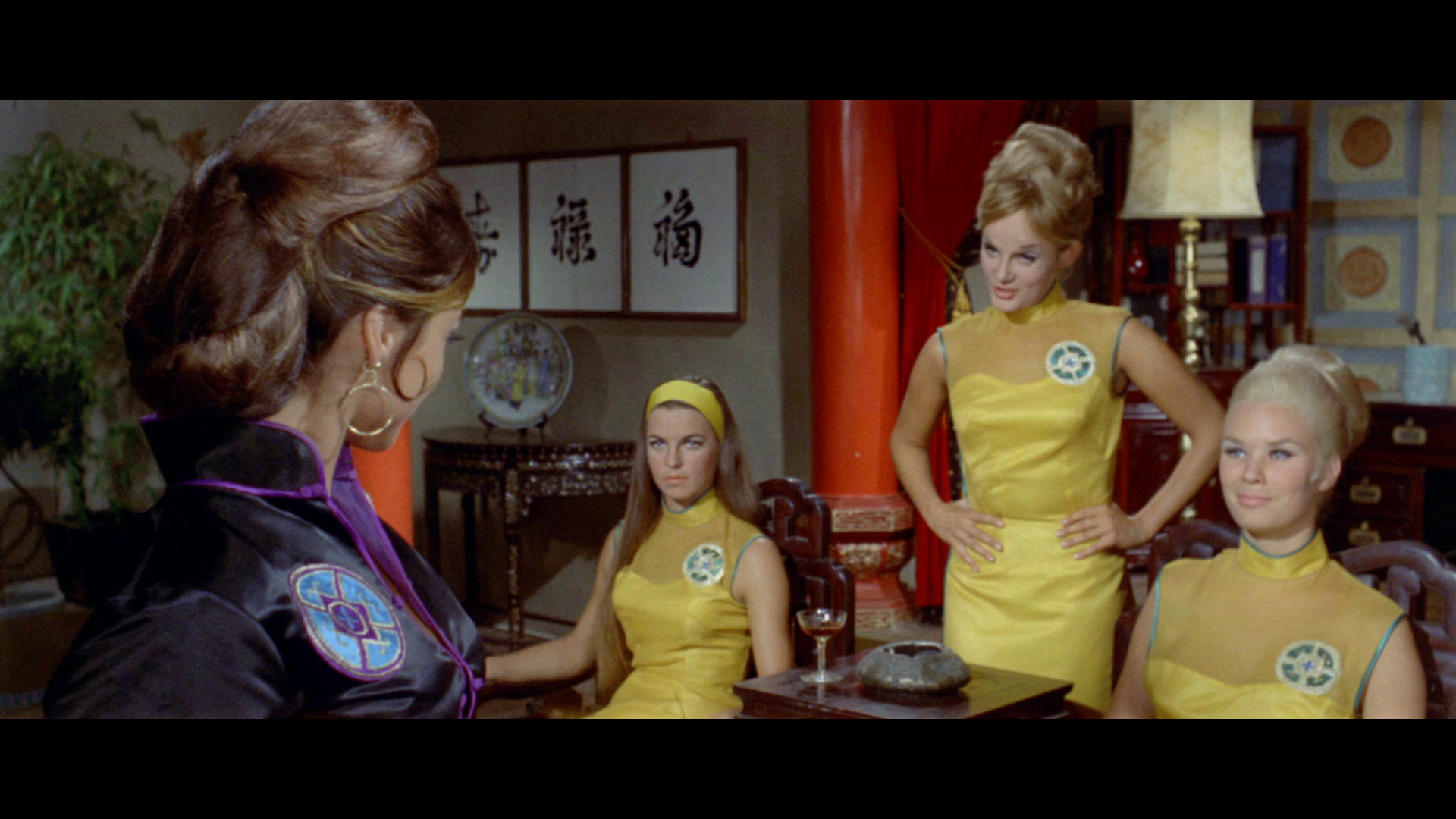
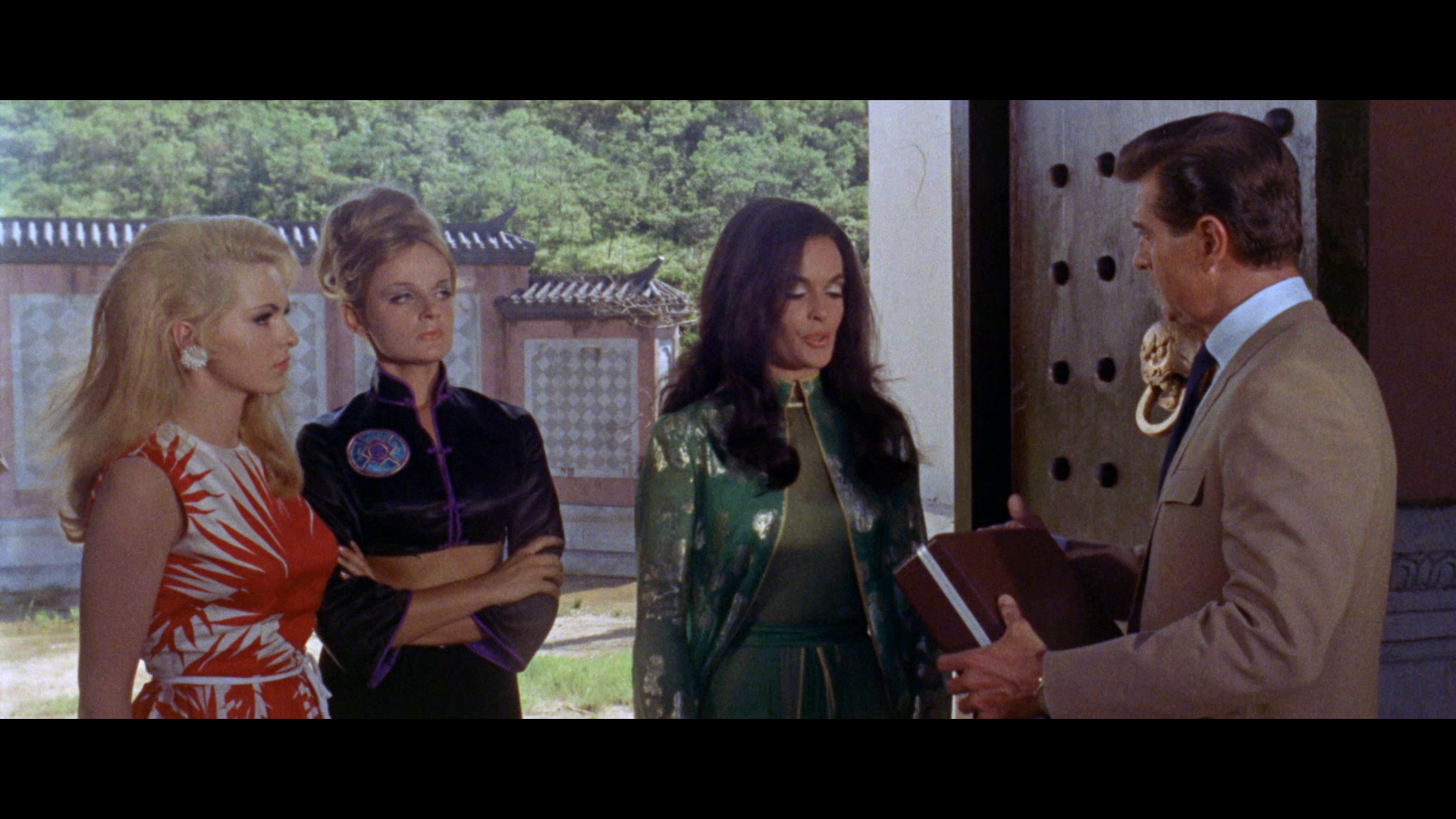
A lot of The Million Eyes of Sumuru's appeal is due to director Lindsay Shonteff's superb visual eye, which beautifully captures the numerous voluptuous women in this film. Other notable films directed by Lindsay Shonteff include Devil Doll, Licensed to Kill (The Second Best Secret Agent in the Whole Wide World), and Clegg. Also, The Million Eyes of Sumuru features many moments of suspense and plenty of action, including an all-out raid on Sumuru’s fortress. Besides action and suspense, there's an ample amount of humor, notably a moment with Klaus Kinski in the role of President Boong.

But this is another very limited and brief role for Klaus Kinski. He just does not show up and become part of the scenery; his portrayal of President Boong is The Million Eyes of Sumuru's most memorable performance. Reportedly, director Lindsay Shonteff said that Klaus Kinski wanted to make his character even more outlandish than what appears on the screen. Some of Klaus Kinski’s ideas that were never used include sporting a very large tongue while licking women and wanting his character to appear from under a pile of cushions whenever someone enters the room.

The two lead male roles, George Nader (Robot Monster) in the role of Nick West and Frankie Avalon (Beach Party) in the role of Tommy Carter, are serviceable performances. That said, they make an odd duo. In the role of the title character, Sumuru, is Shirley Eaton, who most film fans remember from the James Bond film Goldfinger, whose character's death in that film ranks among the most memorable to ever grace the silver screen. Two years later, she would reprise the role of Sumuru in The Girl from Rio. With the role of Sumuru, she would get a chance to show that she was something more than just a beautiful face and body. Other notable performances in The Million Eyes of Sumuru are Wilfrid Hyde-White (My Fair Lady) and Maria Rohm (Marquis de Sade's Justine). Ultimately, The Million Eyes of Sumuru is an entertaining action/adventure that fans of 1960's spy cinema will get a kick out of.

The Million Eyes of Sumuru gets a definitive release from Blue Underground, highly recommended.

Note about the 4K screenshots: It is not possible to make Dolby Vision or HDR10 screenshots that faithfully match the experience of watching a film in motion on a TV. Instead of not having any screenshots, all of the 4K screenshots are m2ts taken with a MPC-HC player and lossless PNGs.


Written by Michael Den Boer

Tuesday, August 2, 2022

The Million Eyes of Sumuru / The Girl from Rio – Blue Underground (Blu-ray)

Theatrical Release Dates: UK, 1967 (The Million Eyes of Sumuru), West Germany/Spain/USA/UK, 1969 (The Girl from Rio)
Directors: Lindsay Shonteff (The Million Eyes of Sumuru), Jesus Franco (The Girl from Rio)
Cast: Frankie Avalon, George Nader, Shirley Eaton, Wilfrid Hyde-White, Klaus Kinski, Maria Rohm (The Million Eyes of Sumuru), Shirley Eaton, Richard Stapley, George Sanders, Maria Rohm, Marta Reves, Elisa Montés, Beni Cardoso, Herbert Fleischmann (The Girl from Rio)

Release Date: July 1st, 2016
Approximate Running Times: 79 Minutes 6 Seconds (The Million Eyes of Sumuru), 94 Minutes 2 Seconds (The Girl from Rio)
Aspect Ratio: 2.35:1 Widescreen / 1080 Progressive / MPEG-4 AVCC (The Million Eyes of Sumuru), 1.66:1 Widescreen / 1080 Progressive / MPEG-4 AVCC (The Girl from Rio)
Rating: NR
Sound: DTS-HD Mono English (Both Films)
Subtitles: English SDH (Both Films)
Region Coding: Region Free
Retail Price: $19.99

"Two years before THE GIRL FROM RIO, Shirley Eaton (GOLDFINGER) also starred as Sumuru, a beautiful but deadly woman with plans for world domination. When a couple of wise-cracking, swingin’ secret agents uncover her scheme to eliminate male leaders and replace them with sexy undercover female operatives, they rush to Hong Kong and enlist the local police to stop her all-female army of assassins known as THE MILLION EYES OF SUMURU.

In the tradition of BARBARELLA and DANGER: DIABOLIK comes this swinging ‘60s action orgy as bisexual super-villain Sumuru (the luscious Shirley Eaton of GOLDFINGER) launches a diabolical plan to enslave the male species with her army of lusty warrior women.

But when Sumuru kidnaps a fugitive American playboy, she crosses a sadistic crime boss (Academy Award® winner George Sanders of ALL ABOUT EVE and VILLAGE OF THE DAMNED) and ignites a battle of the sexes that will bring Brazil to its knees in more ways than one." - synopsis provided by the distributor

Video: 3.5/5 (The Million Eyes of Sumuru), 3/5 (The Girl from Rio)

Here’s the information provided about The Million Eyes of Sumuru's transfer, "newly remastered in High Definition from the original camera negative for its U.S. home video premiere!"

Here’s the information provided about The Girl from Rio's transfer, "fully restored from the original camera negative!"

The Million Eyes of Sumuru and The Girl from Rio come on a 50 GB dual layer Blu-ray.

Disc Size: 41.2 GB

Feature: 16.7 GB (The Million Eyes of Sumuru), 17.5 GB (The Girl from Rio)

Though the source for The Million Eyes of Sumuru is not as pristine as the source used for The Girl from Rio’s transfer, the result is a transfer that looks more organic. That said, source damage is always minor, and though there are some instances of color fading, colors, for the most part, look very good. Also, the image generally looks crisp, and black levels fare well.

Though The Girl from Rio’s new HD transfer has a solid foundation, it suffers from many of the same issues that Blue Underground’s 99 Women’s and Eugenie... the Story of Her Journey into Perversion’s transfers do. Most notably, digital filtering that eliminates many of these new HD transfers' improvements over previous The Girl from Rio home video releases.

Audio: 4.25/5 (The Million Eyes of Sumuru, The Girl from Rio)

The Million Eyes of Sumuru and The Girl from Rio each come with one audio option, a DTS-HD mono mix in English, and included are removable English SDH subtitles for both films. Both the audio mixes are in very good shape. They both sound clean, clear, balanced, and robust when they need to.

Extras:

Extras for this release include a poster & still gallery, a theatrical trailer for The Million Eyes of Sumuru (2 minutes 34 seconds, DTS-HD mono English, no subtitles), trims from The Girl from Rio (6 minutes 6 seconds, no audio) and an archival featurette titled Rolling in Rio (14 minutes 24 seconds, Dolby Digital stereo English and French with non-removable English subtitles).

Summary:

The Million Eyes of Sumuru is one wacky plot that takes all the spy films' most cliched elements and magnifies them tenfold. When it comes to conquering the world and having all men under her thumb, Sumuru has also developed a gun that shoots darts that turn their targets to stone. Two things that add humor to the story at hand are how Nick West, a CIA agent, only cares about his vacation and can’t be persuaded to help save the world until he is framed for murder. Despite its melting pot of ideas, The Million Eyes of Sumuru works in an odd sort of way.

A lot of The Million Eyes of Sumuru's appeal is due to director Lindsay Shonteff's superb visual eye, which beautifully captures the numerous voluptuous women in this film. Other notable films directed by Lindsay Shonteff include Devil Doll, Licensed to Kill (The Second Best Secret Agent in the Whole Wide World), and Clegg. Also, The Million Eyes of Sumuru features many moments of suspense and plenty of action, including an all-out raid on Sumuru’s fortress. Besides action and suspense, there's an ample amount of humor, notably a moment with Klaus Kinski in the role of President Boong.

But this is another very limited and brief role for Klaus Kinski. He just does not show up and become part of the scenery; his portrayal of President Boong is The Million Eyes of Sumuru's most memorable performance. Reportedly, director Lindsay Shonteff said that Klaus Kinski wanted to make his character even more outlandish than what appears on the screen. Some of Klaus Kinski’s ideas that were never used include sporting a very large tongue while licking women and wanting his character to appear from under a pile of cushions whenever someone enters the room.

The two lead male roles, George Nader (Robot Monster) in the role of Nick West and Frankie Avalon (Beach Party) in the role of Tommy Carter, are serviceable performances. That said, they make an odd duo. In the role of the title character, Sumuru, is Shirley Eaton, who most film fans remember from the James Bond film Goldfinger, whose character's death in that film ranks among the most memorable to ever grace the silver screen. Two years later, she would reprise the role of Sumuru in The Girl from Rio. With the role of Sumuru, she would get a chance to show that she was something more than just a beautiful face and body. Other notable performances in The Million Eyes of Sumuru are Wilfrid Hyde-White (My Fair Lady) and Maria Rohm (Marquis de Sade's Justine). Ultimately, The Million Eyes of Sumuru is an entertaining action/adventure that fans of 1960's spy cinema will get a kick out of.

The Girl from Rio was directed by Jess Franco, a prolific filmmaker whose filmography eclipses two hundred films. Over the course of two years, Jess Franco would collaborate with producer Harry Allen Towers on a total of nine films. The Girl from Rio is their second collaboration and their second adaptation of Sax Rohmer's literary works. Also, the screenplay for The Girl from Rio was written by Harry Allan Towers under the pseudonym Peter Welbeck.

Content-wise, there are some elements in The Girl from Rio's plot that have been ported over from The Million Eyes of Sumuru. With none more glaring than Sumuru’s main modus operandi once again being world domination. With that being said, despite the familiarity between these two films, this is a Jess Franco film, after all, and throughout he injects his unique flourishes. Also, there is one slight upgrade in Sumuru’s quest for world domination. This time around she has two foes: an American playboy who also just happens to have secret agent-like skills and a mobster named Masius.

When compared to its predecessor, The Girl from Rio takes on a distinctively different vibe. The look and feel of The Girl from Rio are similar to that of Jess Franco's Lucky, the Inscrutable. While The Million Eyes of Sumuru was more in line with the action/adventure films Towers produced before his collaborations with Jess Franco.

Another way that The Girl from Rio sets itself apart from its predecessor is that it amps up the eroticism, most notably in its depiction of lesbianism in regards to the Sumuru character. And though there was a hint of S&M in The Million Eyes of Sumuru, it is relatively tame compared to The Girl from Rio.

And when discussing the Jess Franco and Harry Alan Towers collaborations, there is one resource that was never lacking, and that is in regard to casting. Shirley Eaton (Goldfinger) is once again cast in the role of Sumuru, and this time around she exudes more confidence in the role. Other notable cast members include George Sanders (Psychomania) in the role of Masius, a ruthless mobster; and Maria Rohm (Venus in Furs) in the role of Lesley, one of Sumuru’s henchwomen. Ultimately, The Girl from Rio is a very satisfying mix of erotica, kitsch, and mayhem.

The Million Eyes of Sumuru and The Girl from Rio get serviceable transfers that leave plenty of room for improvement.


Written by Michael Den Boer

Visitor Q: Limited Edition – New Wave Video (Blu-ray) Theatrical Release Date: Japan, 2001 Director: Takashi Miike Writer: Itaru Era Cast: ...