Showing posts with label Stanley Kubrick. Show all posts

Friday, March 8, 2024

Fear and Desire – Kino Lorber (4k UHD/Blu-ray Combo)

Theatrical Release Date: USA, 1953
Director: Stanley Kubrick
Writer: Howard Sackler
Cast: Frank Silvera, Kenneth Harp, Paul Mazursky, Stephen Coit, Virginia Leith, David Allen, Toba Kubrick

Release Date: February 26th, 2024
Approximate Running Times: 70 Minutes 19 Seconds (Premiere Cut), 60 Minutes 56 Seconds (Theatrical Cut)
Aspect Ratio: 1.37:1 Aspect Ratio / 2160 Progressive / HEVC / H.265 / Dolby Vision HDR10 (4K UHD - Both Versions), 1.37:1 Aspect Ratio / 1080 Progressive / MPEG-4 AVC (Blu-ray - Both Versions)
Rating: NR
Sound: DTS-HD Mono English (Both Versions)
Subtitles: English SDH (Both Versions)
Region Coding: Region Free (UHD), Region A (Blu-Ray)
Retail Price: $39.95

"In this existential drama—which has the feeling of a waking dream rather than a conventional war film—four soldiers return to their senses after crash-landing in a forest behind enemy lines. Blindly navigating their way back to their unit, they attack an isolated cabin occupied by enemy soldiers, then apprehend a peasant woman who is tormented by the deranged young soldier assigned to guard her. On the verge of freedom, they discover an outpost of enemy officers, and must decide whether to slip silently past or stage a violent confrontation with their doppelgängers." - synopsis provided by the distributor

Video: 3.5/5 (4K UHD), 3.5/5 (Blu-ray)

Here’s the information provided about this release's transfer, "Brand New HDR/Dolby Vision Masters for Both Cuts of Fear and Desire – 4K Restorations from the 35mm Camera Negative and Fine Grain."

Fear and Desire comes on a 100 GB triple layer 4K UHD.

Disc Size: 92 GB

Feature: 40.9 GB (Premiere Cut), 26.7 GB (Theatrical Cut)

There are still some instances of source damage that remain, though the source has been cleaned up. When compared to Kino Lorber’s 2012 Blu-ray, this new transfer is a substantial improvement when it comes to image clarity, contrast, and black levels. Unfortunately, there are compression artifacts that make any of the improvements a bigger letdown.

Fear and Desire comes on a 50 GB dual layer Blu-ray.

Disc Size: 45.4 GB

Feature: 17.4 GB (Premiere Cut), 16.4 GB (Theatrical Cut)

This Blu-ray uses the same master that is used for the 4K UHD disc.

Audio: 4.25/5

Both versions come with one audio option, a DTS-HD mono mix in English with removable English SDH. Both audio tracks are in good shape. Dialog comes through clearly; everything sounds balanced, and range-wise, they are satisfactory.

Extras:

Extras on the 4K UHD disc include an audio commentary with film historian Eddy Von Mueller for the premiere cut, an audio commentary with film historian and screenwriter Gary Gerani for the theatrical cut, and three short films directed by Stanley Kubrick: Flying Padre (8 minutes 37 seconds, 1.37:1 aspect ratio, DTS-HD mono English with removable English SDH), Day of the Fight (16 minutes 18 seconds, 1.37:1 aspect ratio, DTS-HD mono English with removable English SDH), and The Seafarers (28 minutes 43 seconds, 1.37:1 aspect ratio, DTS-HD mono English with removable English SDH).

Here’s the information provided about Flying Padre's transfer, “4K restoration from the original 35mm print.”

Here’s the information provided about Day of the Fight's transfer, “4K restoration from the original 35mm print.”

Here’s the information provided about The Seafarers transfer, “4K restoration from the 16mm A/B camera negatives and a 16mm print.”

Extras on the Blu-ray disc include theatrical trailers for Killer’s Kiss (1 minute 48 seconds, DTS-HD mono English, no subtitles), The Killing (1 minute 49 seconds, DTS-HD mono English, no subtitles), and Paths of Glory (3 minutes 3 seconds, DTS-HD mono English, no subtitles), 2012 re-release theatrical trailer for Fear and Desire (1 minute 26 seconds, DTS-HD mono English, no subtitles), 2023 re-release theatrical trailer for Fear and Desire (1 minute 18 seconds, DTS-HD mono English, no subtitles), an audio commentary with Eddy Von Mueller for the premiere cut, an audio commentary with Gary Gerani for the theatrical cut, and three short films directed by Stanley Kubrick: Flying Padre (8 minutes 37 seconds, 1.37:1 aspect ratio, DTS-HD mono English with removable English SDH), Day of the Fight (16 minutes 18 seconds, 1.37:1 aspect ratio, DTS-HD mono English with removable English SDH), and The Seafarers (28 minutes 43 seconds, 1.37:1 aspect ratio, DTS-HD mono English with removable English SDH).

Other extras include reversible cover art and a limited-edition slipcover.

Summary:

After their plane crashes, soldiers search for an escape from enemy territory.

Is it interesting to finally see Fear and Desire after all of these years? It is a film that does not have a good reputation and was directed by Stanley Kubrick, whom many consider the best director ever. The film had a brief run before it quickly disappeared, and Stanley Kubrick disowned the film, calling it the work of an amateur. Needless to say, all of these negatives that I have heard about Fear and Desire have never decreased my interest in seeing it.

In his first feature film, Stanley Kubrick tackled the subject of war, a theme that he would return to in films like Paths of Glory and Full Metal Jacket. Where those two films take place in wars that are clearly defined, in Fear and Desire, the war takes place in an unnamed country, and the identities of the combatants are not revealed. Also, just like those aforementioned films, Fear and Desire explores the effects that war has on those who partake in it.

Though it is easy to disparage a film like Fear and Desire, which undeniably has its faults, There are far worse low-budget films that were made in the 1950s that have attained cult status. Also, if Fear and Desire had been directed by anyone but Stanley Kubrick, or more importantly, by a no-name director who only made a few low-budget films, it would be held in a higher regard.

Even at this early stage of his career, Stanley Kubrick is already establishing traits that he will employ throughout his career. Notably, the way he composes a frame and voice-over narration. The most striking moments all have to do with death. The most memorable scene was between a woman and the soldiers who captured her. This scene, in which the characters have a language barrier, is incredibly effective.

Fear and Desire has two people who would work with Stanley Kubrick on other films. Frank Silvera (Killers Kiss) plays the role of Sergeant Mac, a hot-headed character who clashes with his superior officer. Other notable cast members are Paul Mazursky (Bob & Carol & Ted & Alice), who would go on to become a filmmaker in his own right, and Virginia Leith, who is most known for The Brain That Wouldn't Die. Composer Gerald Fried would work with Stanley Kubrick on Days of the Fight, Killers Kiss, The Killing, and Paths of Glory.

Despite its short running time, Fear and Desire feels much longer than it is. And though the theatrical version tightens things up, it still suffers from lethargic pacing. That said, Fear and Desire is Stanley Kubrick’s worst film, and yet it is still better than a lot of directors' best films.

Kino Lorber gives Fear and Desire a solid release, highly recommended.

Note about the 4K screenshots: It is not possible to make Dolby Vision or HDR10 screenshots that faithfully match the experience of watching a film in motion on a TV. Instead of not having any screenshots, all of the 4K screenshots are m2ts taken with a VLC player and lossless PNGs.


Written by Michael Den Boer

Tuesday, March 5, 2024

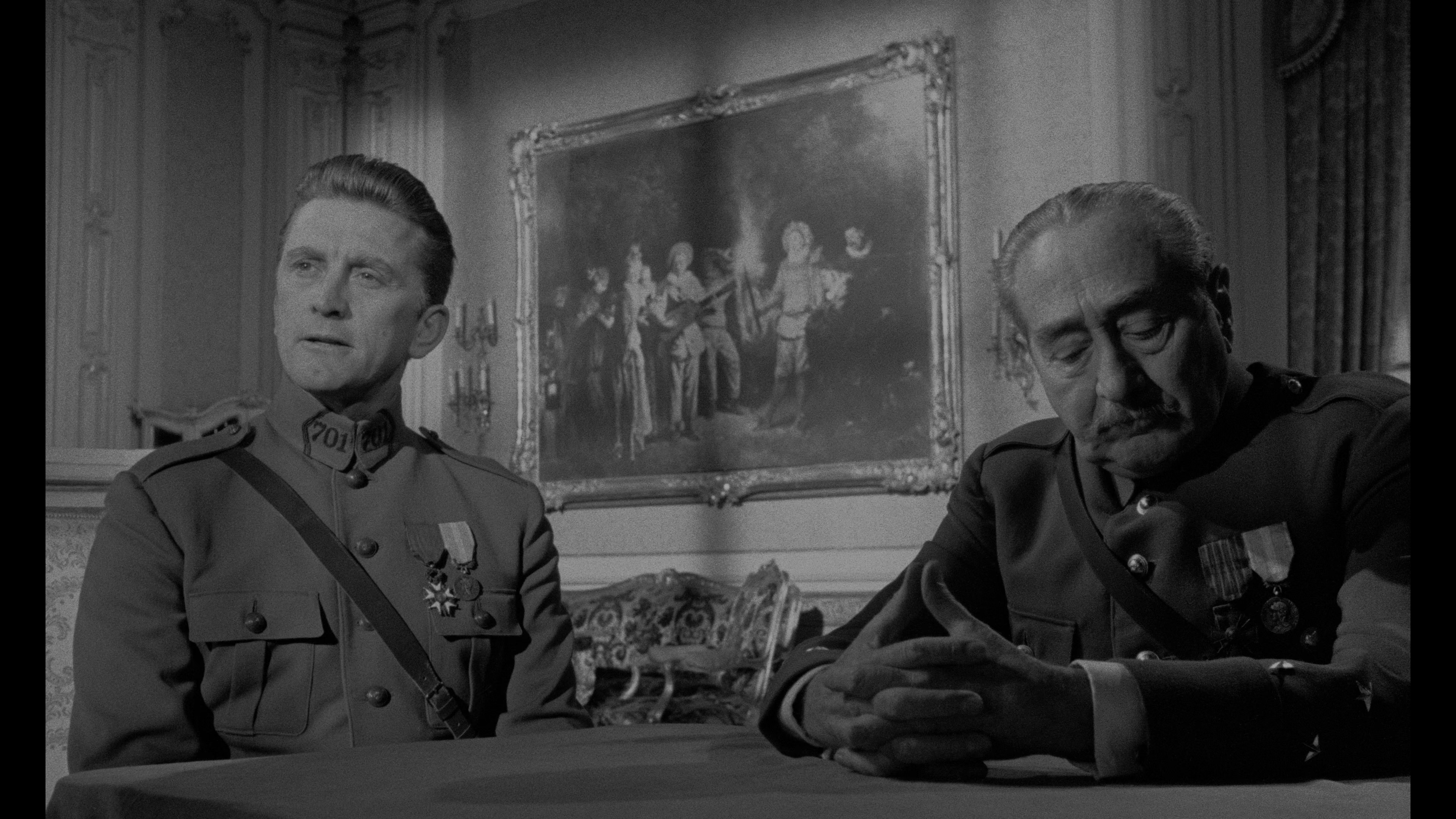
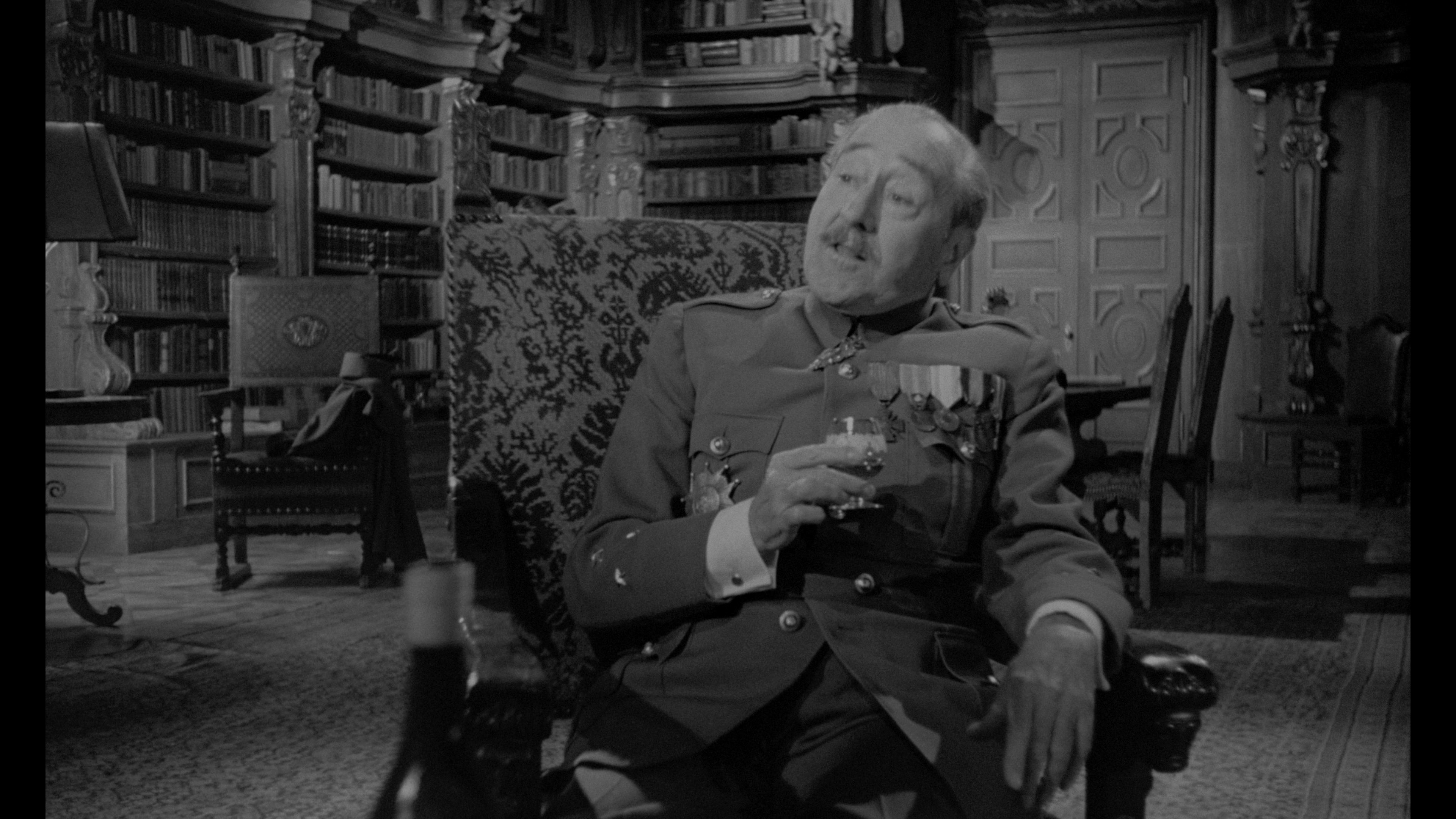
Paths of Glory – Eureka Video (4k UHD)

Theatrical Release Date: USA, 1957
Director: Stanley Kubrick
Writers: Stanley Kubrick, Calder Willingham, Jim Thompson
Cast: Kirk Douglas, Ralph Meeker, Adolphe Menjou, George Macready, Wayne Morris, Richard Anderson, Joe Turkel, Christiane Kubrick, Jerry Hausner, Peter Capell, Emile Meyer, Bert Freed, Timothy Carey, Fred Bell, John Stein

Release Date: February 26th, 2024
Approximate Running Time: 87 Minutes 23 Seconds
Aspect Ratio: 1.66:1 Widescreen / 2160 Progressive / HEVC / H.265 / Dolby Vision HDR10
Rating: PG (UK)
Sound: LPCM Mono English
Subtitles: English SDH
Region Coding: Region Free
Retail Price: £22.99 (UK)

"In the French front lines of World War I, after giving the order for an impossible and disastrous mission to capture a nearby stronghold, the upper ranks move to save face by having three randomly selected soldiers held and tried for cowardice under pain of death. Their leader, Colonel Dax (in a powerhouse performance by Kirk Douglas), a former lawyer in civilian life, handles their defense against overwhelming odds." - synopsis provided by the distributor

Video: 5/5

Here’s the information provided about the transfer, "presented in Dolby Vision HDR from a 4K scan of the original camera negative".

Paths of Glory comes on a 66 GB dual layer 4K UHD

Disc Size: 61.8 GB

Feature: 59.3 GB

This new release takes the solid foundation that Kino Lorber used for their 2022 4K UHD release, tightens everything up, and once again delivers a superior encode from Fidelity in Motion. That said, image clarity, contrast, and black levels are solid, and the image retains an organic look.

Audio: 4.75/5

This release comes with one audio option, a LPCM mono mix in English, and included with this release are removable English SDH. The audio is in great shape; dialog comes through clearly; everything sounds balanced and robust when it should.

Extras:

Extras for this release include a theatrical trailer (3 minutes 1 second, Dolby Digital mono English, no subtitles), an archival interview with film critic and author Richard Combs (9 minutes 58 seconds, Dolby Digital stereo English, no subtitles), an archival interview with Stanley Kubrick scholar Peter Kramer (14 minutes 33 seconds, Dolby Digital stereo English, no subtitles), an archival interview with filmmaker Richard Ayoade (23 minutes 34 seconds, Dolby Digital stereo English, no subtitles), an isolated music & effects track, an audio commentary with film scholar Adrian Martin, an O-card slipcase (limited to 2,000 copies), and a 36-page booklet with cast & crew information, an essay titled Kubrick’s Path, and “Paths of Glory” written by Glenn Kenny, an essay titled The Hollywood War of Independence written by Colin Young, and information about the transfer titled Notes on Viewing. 

Summary:

Looking back at the beginning of Stanley Kubrick's career, it is astounding that for a filmmaker who would often take years from the origins of a film to its final product, he was able to make three films in three years. Though Killer’s Kiss and The Killing can be seen as modest film productions, the same cannot be said for Paths of Glory, a film that at the time was Stanley Kubrick’s most ambitious film.

Stanley Kubrick’s growth as a filmmaker is noticeable with each new film. And though it was impressive how much he was able to grow from Killer’s Kiss to The Killing, it is hard not to understate just how much of a leap it was from Killer’s Kiss to Paths of Glory.

One constant throughout Stanley Kubrick’s filmography is just how diverse a filmmaker he is. Though he returned to recurring themes in most of his films, he rarely worked in the same genre. That is, except for war, which played a role in many of his films.

With Paths of Glory, Stanley Kubrick delivers a damning statement on the atrocities created by wars. The narrative revolves around an impossible military objective that Brigadier General Paul Mireau is determined to carry out, even at the expense of all of his soldiers' lives. When his planned attack does not go off the way he envisioned, Brigadier General Paul Mireau labels the men as cowards, and he demands a court martial to hold the cowards accountable for his leadership failures. From there, a preordained trial of three men is held, followed by their executions.

Though the cinema of Stanley Kubrick is most remembered for his striking visuals, one must not undervalue the performances he was able to get from his cast. And in the case of Paths of Glory, there are no performances that do not rise to the occasion. Of course, Kirk Douglas (Ace in the Hole), in the role of Colonel Dax, delivers another superlative performance. Other notable performances include George Macready (Seven Days in May) in the role of megalomaniac Brigadier General Paul Mireau, and Timothy Carey (One-Eyed Jacks) in the role of Private Maurice Ferol, one of the three men randomly chosen to be executed.

From a production standpoint, it is mind-blowing just how much Stanley Kubrick was able to achieve with the resources he was given for Paths of Glory. The utmost detail in the scenes of carnage as soldiers try to advance upon The Anthill, a position being held by German soldiers, is unflinching in its portrayal of the horrors of war. An iconic moment in Paths of Glory is a tracking shot through the trenches that has all the hallmarks that are synonymous with the cinema of Stanley Kubrick. Another memorable moment is the scene that ends Paths of Glory, in which a German woman sings a poignant song to a hostile crowd, who are eventually won over by the song she is singing. This moment provides a perfect coda to the events that preceded it. Ultimately, Paths of Glory is an extraordinary film that stands firmly as one of cinema’s best anti-war films.

Paths of Glory gets a definitive release from Eureka Video that comes with a solid audio/video presentation and a wealth of insightful extras, highly recommended.

Note about the 4K screenshots: It is not possible to make Dolby Vision or HDR10 screenshots that faithfully match the experience of watching a film in motion on a TV. Instead of not having any screenshots, all of the 4K screenshots are m2ts taken with a VLC player and lossless PNGs.


Written by Michael Den Boer

Monday, August 29, 2022

Paths of Glory – Kino Lorber (4k UHD)

Theatrical Release Date: USA, 1957
Director: Stanley Kubrick
Writers: Stanley Kubrick, Calder Willingham, Jim Thompson
Cast: Kirk Douglas, Ralph Meeker, Adolphe Menjou, George Macready, Wayne Morris, Richard Anderson, Joe Turkel, Christiane Kubrick, Jerry Hausner, Peter Capell, Emile Meyer, Bert Freed, Timothy Carey, Fred Bell, John Stein

Release Date: August 23rd, 2022
Approximate Running Time: 87 Minutes 18 Seconds
Aspect Ratio: 1.66:1 Widescreen / 2160 Progressive / HEVC / H.265 / Dolby Vision HDR10
Rating: NR
Sound: DTS-HD Mono English
Subtitles: English
Region Coding: Region Free
Retail Price: $39.95

"Safe in a picturesque chateau behind WWI front lines, the French General Staff passes down a direct order to Colonel Dax (Kirk Douglas, Lonely Are the Brave): take the Ant Hill at any cost. A blatant suicide mission, the attack is doomed to failure. Covering up their fatal blunder, the generals order the arrest of three innocent soldiers, charging them with cowardice and mutiny. Dax, a lawyer in civilian life, rises to the men’s defense but soon realizes that, unless he can prove that the generals were to blame, nothing less than a miracle will save his clients from the firing squad." - synopsis provided by the distributor

Video: 4.75/5

Here’s the information provided about the transfer, "From 4K Scan of the Original Camera Negative."

Paths of Glory comes on a 66 GB dual layer 4K UHD

Disc Size: 56.2 GB

Feature: 53.8 GB

Image clarity, contrast, and black levels are solid, and the image retains an organic look. This is another solid 4K upgrade from Kino Lorber that is a marked improvement over all previous home video releases for this film.

Audio: 4.75/5

This release comes with one audio option, a DTS-HD mono mix in English, and included with this release are removable English subtitles. The audio is in great shape; dialog comes through clearly; everything sounds balanced and robust when it should.

Extras:

The extras for this release include reversible cover art, a limited-edition slipcover, an audio commentary with novelist and film critic Tim Lucas, and theatrical trailers for Killer’s Kiss (1 minute 46 seconds, DTS-HD mono English, no subtitles), The Killing (1 minute 46 seconds, DTS-HD mono English, no subtitles), and Paths of Glory (3 minutes, DTS-HD mono English, no subtitles).

Summary:

Looking back at the beginning of Stanley Kubrick's career, it is astounding that for a filmmaker who would often take years from the origins of a film to its final product, he was able to make three films in three years. Though Killer’s Kiss and The Killing can be seen as modest film productions, the same cannot be said for Paths of Glory, a film that at the time was Stanley Kubrick’s most ambitious film.

Stanley Kubrick’s growth as a filmmaker is noticeable with each new film. And though it was impressive how much he was able to grow from Killer’s Kiss to The Killing, it is hard not to understate just how much of a leap it was from Killer’s Kiss to Paths of Glory.

One constant throughout Stanley Kubrick’s filmography is just how diverse a filmmaker he is. Though he returned to recurring themes in most of his films, he rarely worked in the same genre. That is, except for war, which played a role in many of his films.

With Paths of Glory, Stanley Kubrick delivers a damning statement on the atrocities created by wars. The narrative revolves around an impossible military objective that Brigadier General Paul Mireau is determined to carry out, even at the expense of all of his soldiers' lives. When his planned attack does not go off the way he envisioned, Brigadier General Paul Mireau labels the men as cowards, and he demands a court martial to hold the cowards accountable for his leadership failures. From there, a preordained trial of three men is held, followed by their executions.

Though the cinema of Stanley Kubrick is most remembered for his striking visuals, one must not undervalue the performances he was able to get from his cast. And in the case of Paths of Glory, there are no performances that do not rise to the occasion. Of course, Kirk Douglas (Ace in the Hole), in the role of Colonel Dax, delivers another superlative performance. Other notable performances include George Macready (Seven Days in May) in the role of megalomaniac Brigadier General Paul Mireau, and Timothy Carey (One-Eyed Jacks) in the role of Private Maurice Ferol, one of the three men randomly chosen to be executed.

From a production standpoint, it is mind-blowing just how much Stanley Kubrick was able to achieve with the resources he was given for Paths of Glory. The utmost detail in the scenes of carnage as soldiers try to advance upon The Anthill, a position being held by German soldiers, is unflinching in its portrayal of the horrors of war. An iconic moment in Paths of Glory is a tracking shot through the trenches that has all the hallmarks that are synonymous with the cinema of Stanley Kubrick. Another memorable moment is the scene that ends Paths of Glory, in which a German woman sings a poignant song to a hostile crowd, who are eventually won over by the song she is singing. This moment provides a perfect coda to the events that preceded it. Ultimately, Paths of Glory is an extraordinary film that stands firmly as one of cinema’s best anti-war films.

Paths of Glory makes its way to 4K UHD via an excellent release from Kino Lorber that comes with a solid audio/video presentation and an exceptional audio commentary that is filled with insight about Paths of Glory and Stanley Kubrick, highly recommended.

Note about the 4K screenshots: It is not possible to make Dolby Vision or HDR10 screenshots that faithfully match the experience of watching a film in motion on a TV. Instead of not having any screenshots, all of the 4K screenshots are m2ts taken with a VLC player and lossless PNGs.


Written by Michael Den Boer

Tuesday, August 23, 2022

A Clockwork Orange – Warner Brothers (4k UHD/Blu-ray Combo)

Theatrical Release Date: UK/USA, 1971
Director: Stanley Kubrick
Writer: Stanley Kubrick
Cast: Malcolm McDowell, Patrick Magee, Michael Bates, Warren Clarke, Michael Tarn, John Clive, Adrienne Corri, Carl Duering, Miriam Karlin, Philip Stone, David Prowse

Release Date: September 21st, 2021
Approximate Running Time: 136 Minutes 35 Seconds
Aspect Ratio: 1.66:1 Widescreen / 2160 Progressive / HEVC / H.265 / HDR10
Rating: R
Sound: DTS-HD 5.1 English, Dolby Digital Mono English, DTS-HD 5.1 French, DTS-HD 5.1 German, DTS-HD 5.1 Italian, DTS-HD 5.1 Spanish (Castilian), DTS-HD 5.1 Spanish (Latin), Dolby Digital Mono Polish
Subtitles: English SDH, French, German SDH, Italian SDH, Spanish (Castilian), Spanish (Latin), Cantonese, Mandarin, Czech, Danish, Dutch, Finnish, Hungarian, Korean, Norwegian, Polish, Swedish
Region Coding: Region Free
Retail Price: $33.99

"Set in a futuristic welfare state, a vicious young hoodlum is captured by the police and undergoes rehabilitation in the form of aversion therapy as brutal and horrifying as any of his offenses." - synopsis provided by the distributor

Video: 4.75/5 (4K UHD), 3.75/5 (Blu-ray)

A Clockwork Orange comes on a 66 GB dual layer 4K UHD.

Disc Size: 58.8 GB

Feature: 58.2 GB

Warners Brothers has done an amazing job with all their Stanley Kubrick 4K UHD releases. As good as Warner Brothers' 2011 Blu-ray looked, this new 4K transfer is a noticeable improvement in every area. The most notable areas of improvement include stronger contrast and black levels; image clarity and fine details have never looked better; and film grain is better managed.

A Clockwork Orange comes on a 50 GB dual layer Blu-ray.

Disc Size: 34.4 GB

Feature: 26.1 GB

It should be noted that the Blu-ray is the same disc that Warner Brothers released in 2011, minus a second disc that contained O Lucky Malcolm! and Stanley Kubrick: A Life in Pictures.

Audio: 3.5/5 (DTS-HD 5.1 English), 4.25/5 (Dolby Digital Mono English)

The 4K UHD disc comes with these audio options, a DTS-HD 5.1 mix in English; a Dolby Digital mono mix in English; a DTS-HD 5.1 mix in French; a DTS-HD 5.1 mix in German; a DTS-HD 5.1 mix in Italian; a DTS-HD 5.1 mix in Spanish (Castilian), a DTS-HD 5.1 mix in Spanish (Latin), and a Dolby Digital mono mix in Polish. For this review, I listened to the two English language tracks. The DTS-HD 5.1 English language track is one of the weaker remix tracks of a film that was originally released in mono that I have heard. Though the mix spreads things out more, the distribution of sound leaves a lot to be desired, especially when compared to the original mono track. That said, despite only being available in Dolby Digital, the original mono mix provides a much more satisfying sound experience. Included with this release are these removable subtitle options: English SDH, French, German SDH, Italian SDH, Spanish (Castilian), Spanish (Latin), Cantonese, Mandarin, Czech, Danish, Dutch, Finnish, Hungarian, Korean, Norwegian, Polish, Swedish.

Extras:

Extras on the 4K UHD disc include an archival audio commentary with actor Malcolm McDowell and film historian Nick Redman.

Extras on the Blu-ray disc include original theatrical trailer (1 minutes 3 seconds, Dolby Digital mono English and English SDH, French, German, Italian, Spanish (Castilian), Spanish (Latin), Cantonese, Mandarin, Portuguese (Brazil), Danish, Dutch, Finnish, Norwegian, Swedish subtitles), an archival interview with actor Malcolm McDowell titled Malcolm McDowell Looks Back (10 minutes 30 seconds, Dolby Digital stereo English and English SDH, French, German, Italian, Spanish (Castilian), Spanish (Latin), Cantonese, Mandarin, Portuguese (Brazil), Danish, Dutch, Finnish, Norwegian, Swedish subtitles), an archival featurette titled Turning Like Clockwork (26 minutes 19 seconds, Dolby Digital stereo English and English SDH, French, German, Italian, Spanish (Castilian), Spanish (Latin), Cantonese, Mandarin, Portuguese (Brazil), Danish, Dutch, Finnish, Norwegian, Swedish subtitles), an archival featurette titled Great Bolshy Yarblockos! Making A Clockwork Orange (28 minutes 19 seconds, Dolby Digital stereo English and English SDH, French, German, Italian, Spanish (Castilian), Spanish (Latin), Cantonese, Mandarin, Portuguese (Brazil), Danish, Dutch, Finnish, Norwegian, Swedish subtitles), an archival featurette titled Still Tickin': The Return of A Clockwork Orange (43 minutes 42 seconds, Dolby Digital stereo English and English SDH, French, German, Italian, Spanish (Castilian), Spanish (Latin), Cantonese, Mandarin, Portuguese (Brazil), Danish, Dutch, Finnish, Norwegian, Swedish subtitles) and an archival audio commentary with Malcolm McDowell and Nick Redman.

Other extras include a slipcover.

Summary:

I have lost track of how many times I have seen A Clockwork Orange (at least over fifty times). My journey with A Clockwork Orange began when I first saw it on cable. From there, I have watched it on just about every home video format: VHS, Laserdisc, DVD, HD-DVD, Blu-ray, and 4K UHD. And though most films become familiar the more you revisit them, I am continually amazed by the many new things I see each time I watch A Clockwork Orange.

Censorship has always played a role in what eventually ends up on the screen. When A Clockwork Orange was first unleashed on unsuspecting audiences, there was already a movement for cinema to expand upon its previous imposed restrictions. That said, in the fifty-one years since A Clockwork Orange shocked audiences, there seems to be a movement to censor content, and this is often done in the name of doing so for the better good of society. The irony of such a scenario ties in with the central theme of A Clockwork Orange, the danger of imposing morality.

Though many of the elements and themes explored in A Clockwork Orange were radical for their time, it is astounding just how much has become commonplace in today's world where violence is everywhere you look and the totalitarian movement to control every aspect of one's life for the better has gained considerably. Looking back, it is a stroke of genius on Stanley Kubrick’s part to set the film in a near enough future that in such a short time we now live in it.

With A Clockwork Orange, it creates a cinematic experience that forms a perfect fusion of sights and sounds. And though music has long played a role in cinema, the way in which Stanley Kubrick uses music in A Clockwork Orange goes beyond using said music to evoke an emotional response. Also, the way in which he frames compositions takes you out of the role of a spectator by creating a claustrophobic atmosphere that forces you to confront the carnage on screen.

For a film with so many striking visual moments. Some of the most memorable are the opening sequence, which introduces Alex and his droogs; the home invasion scene, where Alex and his droogs assault a writer and rape his wife; and Alex’s treatment sequences at Ludovico, especially the scene where his eyes are forced to remain open while watching disturbing images.

All areas of film production can make or break a film. When it comes to casting a film, there is arguably no area more important. In the case of A Clockwork Orange, it is hard to imagine an actor besides Malcolm McDowell (If....) in the role of Alex DeLarge, a nasty character who is the pure essence of evil. He delivers such an astonishingly convincing performance that it is the best of his career. That said, the rest of the cast are all great in their roles, even if they are overshadowed by Malcolm McDowell’s performance.

It is not surprising that A Clockwork Orange is a film where everything perfectly falls into place, since it is well known that Stanley Kubrick was a meticulous filmmaker who would continue to work on something until he was satisfied with it. And though A Clockwork Orange was one of his more scaled-down films from a production standpoint, the result is an extraordinary film that does a superb job of capturing the essence of Anthony Burgess’s source novel. That said, it is arguably cinema’s best example of a novel to film adaptation.

A Clockwork Orange makes its way to 4K UHD via a solid transfer from Warner Brothers and an assortment of insightful extras, highly recommended.

Note about the 4K screenshots: It is not possible to make Dolby Vision or HDR10 screenshots that faithfully match the experience of watching a film in motion on a TV. Instead of not having any screenshots, all of the 4K screenshots are m2ts taken with a VLC player and lossless PNGs.


Written by Michael Den Boer

Visitor Q: Limited Edition – New Wave Video (Blu-ray) Theatrical Release Date: Japan, 2001 Director: Takashi Miike Writer: Itaru Era Cast: ...